Selected work / Foundations to Mastery
From diagnostic evidence to a reviewed learning path.
A tutoring practice and launch-stage instructional platform built around the decisions educators and families actually need to make.
The system
One connected learning cycle.
A diagnostic should lead to clear evidence, a human decision, useful instruction, and a way to see what changed.
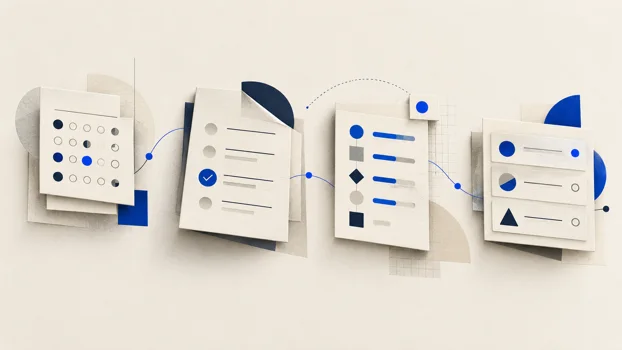
Conceptual illustration. No learner records or private interface are shown.
- 01Collect evidence
The current K–8 mathematics diagnostic can capture answers and reasoning in more than one form.
- 02Interpret carefully
Scoring distinguishes a keyable answer from work that needs judgment, with provenance retained.
- 03Review with an educator
An educator confirms the family-facing report and the next learning cycle.
- 04Teach and practice
A reviewed path connects prerequisite needs to explicit instruction, practice, and support.
- 05Check for mastery
New evidence informs what happens next rather than ending the story at one score.
Engineering decisions
Make judgment visible in the software.
The platform’s hard problems are about responsibility and continuity as much as screens.
Question-owned rubrics
Each diagnostic question carries the criteria used to interpret its components. A correct final answer and the reasoning behind it remain different kinds of evidence.
Human release gates
Model-assisted work supports the educator; it does not silently publish a report or a new learning cycle to a family.
Role-aware workflows
Learner, guardian, tutor, and staff views depend on relationships and permissions, so continuity does not require broad access.
Traceable next actions
Reports, placement, courses, entitlements, and staff queues are modeled as connected work rather than isolated features.
What this proves
Full-stack ownership in a real service context.
The current repository spans React and Vite interfaces, Supabase and Postgres services, Edge Functions, row-level security, model-assisted evaluation, educator review, and the operational tools that support a live tutoring practice. Repository implementation and production reach are different claims; this case study describes the implemented system and the practice it serves.
My contribution was not one feature. I worked across product definition, user journeys, data and access boundaries, AI review behavior, and the details that let staff, educators, learners, and families keep context over time.
Next project
Seed Health
From a working personalization demo to an integrated member experience.
Explore the case study →Build note
How evidence becomes a path
A closer look at the decisions behind a diagnostic workflow.
Read the note →